A comprehensive new guide has been issued to assist individuals new to hunting, outlining the fundamental requirements and best practices for a safe and successful experience in the field. The detailed resource covers legal preparation, essential gear, safety protocols, and ethical animal recovery, offering a foundational roadmap for the upcoming 2026 hunting season.
For anyone considering taking up hunting in South Carolina, the guide underscores the absolute necessity of completing a state-approved hunter education course. These courses are designed to instill critical knowledge regarding firearm safety, wildlife conservation, hunting ethics, and state-specific regulations. Options for completing these courses typically include traditional classroom instruction complemented by a practical field day, or online instruction followed by a mandatory field day. In some states, fully online coursework is available for adults, though South Carolina often requires a hands-on component to ensure proficiency and understanding of safe handling and field practices. This educational foundation is paramount for ensuring that new hunters are not only compliant with the law but also equipped with the skills to operate responsibly in natural environments like those found in Laurens County, including areas within the Sumter National Forest – Enoree District.
Beyond education, securing the correct hunting license and species-specific tags is a non-negotiable step. The guide emphasizes that hunting regulations are highly variable, changing significantly by state, specific game unit, and even the type of weapon used. For instance, season dates for deer, turkey, or small game will differ, as will legal weapons, minimum calibers or draw weights for bows, and bag limits. Furthermore, requirements for tagging and reporting harvested animals are strictly enforced and vary based on the species and location. Hunters in Clinton and the surrounding region must meticulously research and adhere to South Carolina’s specific regulations, which can be complex and are subject to annual updates. Ignorance of the law is not an excuse, and local law enforcement, including the Laurens County Sheriff’s Office under Sheriff Larry Dean, maintains a vigilant stance on compliance to ensure public safety and wildlife management.
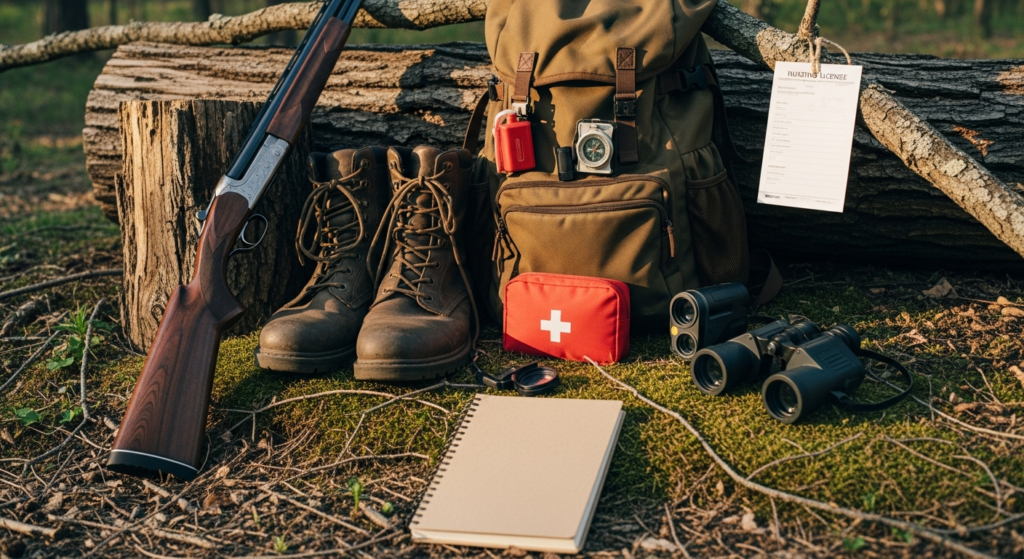
Equipping oneself properly is another significant aspect detailed in the guide. Recommended core equipment for new hunters includes a legal weapon—be it a rifle, shotgun, or compound bow—along with sufficient practice ammunition or arrows to ensure proficiency. Licenses and tags must always be carried. Hunter orange, a highly visible safety color, is often required by state law, particularly during certain seasons, to enhance visibility and prevent accidents. Practical clothing is also crucial; broken-in boots, layered clothing suitable for varying weather conditions, and a reliable day pack are essential. Other vital items include binoculars for spotting game, sufficient water and high-calorie snacks, a headlamp with extra batteries for low-light conditions, a sharp knife for field dressing, and a comprehensive first-aid kit for emergencies. The guide also provides approximate costs for entry-level gear, estimating $450–$800 for a basic rifle with a scope, $350–$700 for a versatile shotgun, and $400–$900 for a compound bow package. Essential apparel like boots and clothing layers might cost $200–$400, while entry-level binoculars range from $100–$250. These figures represent a significant initial investment for new participants in the sport.
Safety is given paramount importance in the guide, with a strong emphasis on the four fundamental rules of firearm safety: treating every firearm as if it were loaded, always keeping the muzzle pointed in a safe direction, keeping one’s finger off the trigger until ready to shoot, and positively identifying the target, what is in front of it, and what is beyond it. These rules are critical for preventing accidental discharges and ensuring the safety of the hunter and others in the vicinity. For hunters utilizing elevated stands, the guide strongly advises the use of a full-body harness, a lineman’s belt, and a lifeline to prevent falls, which are a leading cause of serious injury among hunters. These safety measures are not merely suggestions but essential practices that local law enforcement and wildlife agencies advocate vigorously.
Once an animal has been successfully harvested, the guide provides clear instructions for ethical recovery and processing. It recommends immediately tagging the animal as required by state law, which typically involves attaching the appropriate tag to the carcass to prevent poaching and ensure legal compliance. Rapid cooling of the meat is essential to preserve its quality, especially during the warmer summer months in South Carolina. Keeping the meat clean during field dressing and transport is also critical. The guide advises following species- and state-specific rules for field dressing and transportation, which can vary widely. For those who prefer professional assistance, the estimated cost for processing an animal ranges from $80 to $200 or more, depending on the animal’s size and the services requested. This cost is an important consideration for hunters in Clinton planning their budget for the season.
Why it matters in Clinton
The availability of a comprehensive beginner hunting guide holds particular significance for Clinton and the broader Laurens County community. With its proximity to natural areas like the Sumter National Forest – Enoree District and Lake Greenwood, the region offers ample opportunities for outdoor recreation, including hunting. The guide’s emphasis on safety and legal compliance is crucial for ensuring that new participants contribute positively to the local hunting culture and minimize risks. For institutions like Presbyterian College, the guide could be a valuable resource for students interested in outdoor activities, promoting responsible engagement with the natural environment. Furthermore, the economic impact of hunting, from equipment purchases to professional meat processing services, supports local businesses and contributes to the economic vitality of Clinton, making responsible participation a benefit for the entire community.